Reducing greenhouse gas emissions is certainly the most important, but not the only, objective of systematic energy management.
The ISO 50001-certified energy management system is designed to continuously improve your company’s energy performance and focuses on energy efficiency, energy use and energy consumption.
The resulting cost reductions and optimisations in energy use and energy balances have a positive impact on your market position and your company’s image.
An energy management system compliant with ISO 50001 provides the ideal basis for companies of all sizes, both nationally and internationally, to demonstrate their competence and performance. A key advantage is that the standard can be implemented across all sectors – in both manufacturing and service organisations.
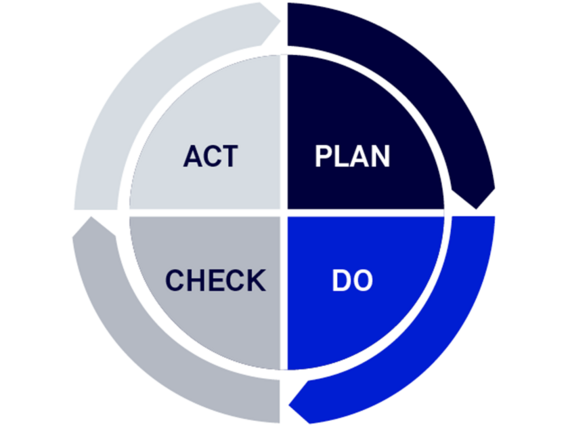
ISO 50001 is an internationally recognised standard. It is structured in accordance with the ‘High Level Structure’ (HLS) and is based on the ‘Plan-Do-Check-Act’ (PDCA) model. The High Level Structure enables the integration of various management systems; the PDCA cycle ensures a continuous improvement process.
Energy management in accordance with ISO 50001 follows a systematic, data-driven, fact-based and holistic approach and applies to processes, products, services and activities that have an impact on energy performance. The organisation itself identifies the significant energy uses (SEUs) and defines the scope, objectives and energy performance indicators (EnPIs). In doing so, a proactive approach to opportunities and risks is important in order to minimise or prevent undesirable effects.

The ‘Plan-Do-Check-Act’ model ensures continuous improvement, enabling the energy management system to demonstrate its effectiveness through four recurring phases.
Plan phase: The organisation examines its context in detail and establishes an energy policy. In addition, the initial energy baseline is analysed, significant energy uses (SEUs) are identified and energy performance indicators (EnPIs) are defined. From this, the company derives (energy) targets and translates them into action plans.
Do phase: Here, the energy management system is introduced and implemented. This includes structural measures relating to energy performance, as well as systematic communication and the empowerment of employees regarding the energy management system.
Check phase: It is the company’s responsibility to monitor, measure, analyse and evaluate energy-related performance, which in turn culminates in the so-called management review.
Act phase: Finally, new measures for the continuous improvement of energy performance and the energy management system are decided upon and implemented.
The German Accreditation Body (DAkkS) has transitioned the accreditation of TÜV NORD CERT GmbH (TN CERT) to the international accreditation standard DIN ISO 50003:2022 with effect from 2 August 2023.
The transition will result in changes to the calculation rules, as well as to the conduct and documentation of audits. Your certificates and, where applicable, sub-certificates will not be affected by the transition.
For existing customers, the new calculation rule will only apply from the next recertification. The changes regarding audit procedures and documentation, however, apply with immediate effect, i.e. they will be implemented in the next audit of the current certification cycle.
For new customers, both the amended calculation rule and the changes regarding audit procedures and documentation apply with immediate effect.
We have summarised the key changes for you below:
Several sites may be treated as a single site if they are located in close proximity to one another; in other words, the number of staff involved in the EnMS, the types of energy, energy consumption and the number of SEUs are aggregated.
Is your company looking to submit an application for a reduction in electricity levies under the Energy Financing Act (EnFG), or for a grant under the BECV Carbon Leakage Regulation (BECV) or the SPK Funding Guidelines (SPK)?
If so, we would be delighted to send you details of our supplementary services in connection with your existing certification to DIN EN ISO 50001:2018 or EMAS. As your trusted partner in the fields of testing, inspection and certification, our aim is always to provide you with the highest quality and reliability in our services.
Our current supplementary offer covers the review and confirmation of specific requirements in accordance with current legal regulations. These additional services can be provided either as part of the regular on-site audit or as a separate remote assessment (desk review). The contractual agreements of your existing certification and surveillance under ISO 50001:2018 or EMAS also apply to this supplementary offer.
Please complete the attached order form in full. Enter your company details under No. 1 and No. 2 and specify the respective scope of implementation of the services under No. 3 a) – 3 c). Please return the completed and signed form to us.
An Integrated Management System (IMS) brings together an organisation’s various management systems – such as quality, environmental, energy and occupational health and safety management – within a single, unified framework. This promotes a consistent approach to work, enhances efficiency and transparency, and offers numerous benefits:
Higher staff motivation: Transparency and clear objectives promote acceptance and identification.
An IMS improves efficiency, reduces costs, increases transparency and collaboration, and facilitates compliance with regulatory requirements. Careful planning and implementation are essential for success, with the High Level Structure (HLS) serving as the central framework to facilitate the integration of the various standards.

In a joint statement issued in February 2024, the International Accreditation Forum (IAF) and the International Organisation for Standardisation (ISO) outlined the amendments to various management system standards. The statement emphasises the importance of addressing climate change within these management systems.
The amendments affect clauses 4.1 and 4.2 of the respective standard. The aim of the amendments is to ensure that organisations take climate change issues into account in relation to the effectiveness of management systems, in addition to all other aspects.
ISO 50001 is an internationally recognised standard that sets out the requirements for an organisation’s or company’s energy management system. It is designed to support the implementation of a practical, systematic energy management system aimed at achieving more efficient energy use.
In principle, there is no obligation to obtain certification, and the introduction of an energy management system is also voluntary. However, in Germany, certification to ISO 50001 is a prerequisite for significant tax relief, such as the peak load compensation scheme or the cap on the EEG surcharge.
Manufacturing companies use the energy management system to apply for peak load compensation (Section 10 of the Electricity Tax Act, Section 55 of the Energy Tax Act) or the EEG surcharge cap (Section 64 of the Renewable Energy Sources Act).
The cost of upgrading for the transition to the new standard has been set by the German Accreditation Body (DAkkS) as follows:
As was the case with ISO 9001 and ISO 14001, the so-called High Level Structure has also been introduced in ISO 50001. This ensures consistent naming and numbering of the standard’s chapters, as well as consistent definitions of terms.
The organisation must identify internal and external influences that are relevant to the energy management system and that may have a positive or negative impact on the organisation.
In future, the organisation must identify and define the interested parties relevant to its energy management system, as well as their requirements and expectations.
Organisations must address existing and potential opportunities and risks relating to their energy management system and plan their activities accordingly.
DIN EN ISO 50001 places greater emphasis than before on management’s responsibility for establishing and operating the energy management system.
In connection with the monitoring, measurement and analysis of energy performance, the requirements regarding methodology have increased.
Under Sections 8 et seq. of the Energy Services Act (EDL-G), all companies that do not qualify as small and medium-sized enterprises (SMEs) within the meaning of Recommendation 2003/361/EC are required to carry out an energy audit in accordance with DIN EN 16247-1 at least every four years. Companies that operate a certified energy management system in accordance with ISO 50001 or can demonstrate EMAS III validation are exempt from this obligation.
This applies to all so-called ‘non-SMEs
’: - companies with ≥ 250 employees or
- companies with an annual turnover of > €50 million or
- companies with an annual balance sheet total of > €43 million
It should be noted that affiliated companies must also be taken into account when classifying a company as an SME or a non-SME. More detailed information on the SME definition can be found in the European Commission’s guidance.
For information on how to establish an energy management system based on an energy audit and how to identify and assess efficiency potential, please refer to the Federal Environment Agency’s guide “Energy Management Systems in Practice”.
TÜV NORD CERT is an internationally recognised and reliable partner for testing and certification services. Our experts and auditors possess in-depth knowledge and are all permanently employed by TÜV NORD. This ensures independence, impartiality and continuity in the support we provide to our clients. The benefit for you is clear: our auditors accompany and support the development of your business and provide you with objective feedback.